This will generate Open Graph meta tags for t
Showing posts with label Community-based Art. Show all posts

Ice Henge, in Honor of Adam


A year ago I wrote "Twenty things I love about Adam Green" for him as a birthday present. His birthday is today, and now it has been over a year since he killed himself. Many people on the east side of Madison know him as a a jovial character who frequented St. Vinnies and made artwork out of found objects. His collection of Zeppelin paintings were distributed after his death and now hang in homes all over the city and beyond.

Adam was a huge inspiration to me. He lived life artfully and encouraged others to do the same.

#2 on my list of things I appreciate about him is this: I love Adam Green for fascinating on wild ideas. Ideas that are possible but unlikely to be realized, ideas that bust open the fixed sensibility of things.

The photos below of a temporary art piece are for him, because I know he would have appreciated both the ice sculpture and the photos I took. And because I wish I could have a conversation with him about it. We would talk about what made those five guys from Lake Mills do it? And we'd talk about exactly how they made the sculpture, and other things they could do to play more with the concept. 

It is a beautiful and fun piece of winter wonder, and now it, too, is gone.

I've read that it took two days to build after years of thinking, learning to cut ice, and surely many encounters with doubters who questioned the sanity of building something so ephemeral, so useless, so difficult. And then, after a couple weeks of glory, it was taken down. Some worried the heavy blocks of ice would crash down when the weather warmed and possibly hurt someone. 

Because, it turns out, people were flocking to see the thing. When I went, there was a heavy stream of cars parking and people marching on the icy path to snap pictures. My own pictures were taken carefully so they hide the fact that it was so crowded.  

But truly, what I love most about the whole thing is that it was so crowded. Those five guys went to the trouble to put their big idea out there, and people loved it. People flocked to see what they created. Adam would have appreciated that.

I also really want to tell Adam about what I've been working on. It is an exciting collaborative effort for all of us to enjoy this summer. More on this to come over the months, but the end products will include an enhanced landscape on East Johnson Street, a chalk mural I'm designing, and several invitations to hang out with your neighbors in Reynolds Park this summer. Imagining picnics in the park and planters full of flowers is a perfect distraction when outside the weather is starting to get tiresome. 

The project is a collaboration between the Friends of Reynolds Park, the Cap East Business Association, and the Tenney-Lapham Neighborhood Association

The Friends of Reynolds Park is the group I represent and I'm getting to know the other two groups better as we go along. We really all have the same goal: to make the neighborhood a bit nicer through community involvement. 

I'm so impressed by the character of the people involved and marvel at how much each of these individuals gives freely of his or her time and energy. I'm learning from these hardworking, visionary people, many of whom have lived here much longer than I have and whose commitment to the neighborhood has made it all it is today. 

And today, there are many pressures on the neighborhood, in the state of Wisconsin, and in the world, frankly. Still, people impress me. Oh, plenty disappoint me, too. But I learn so much from the ones who have an internal compass pointing them toward community, a generosity with which they share their gifts, and a light-heartedness about it all. 

I look forward to sharing more about the collaboration, and summer fun in the neighborhood, in the next couple months!


How I transformed this space, just a little bit


I have reworked this digital space a bit recently. I wanted to make it more beautiful, but am limited by the restrictions of the blogger geography and my own capabilities. So, I just added some pages to help organize my ideas.


It is not unlike the art I've been doing this winter: simple embellishments to the familiar landscape.


Years ago, when my husband and I were still dating, we stopped for a hike at a little patch of woods off the highway on the outskirts of Madison. My memory of that hike feels like a dream. We left the main trail to follow a little 'deer path' that led us into a world of sculpted vines and created space. The stones and logs were placed to create small coves beneath dense canopies. It was both totally natural and utterly magical.


We never figured out if the space was created by artists or by area children.


I was reminded of that artful installation within the woods today when I looked at some pictures a friend shared with me.


I added a section that I hope answers the questions I often ask myself, like Why do I enjoy creating this digital space for myself so much? And what is it for?


I've also made it easier to subscribe (see the right sidebar) and added some local sponsors. Thanks for looking around here, and outside, and exploring with me. Keep sending me links, too, I love that!


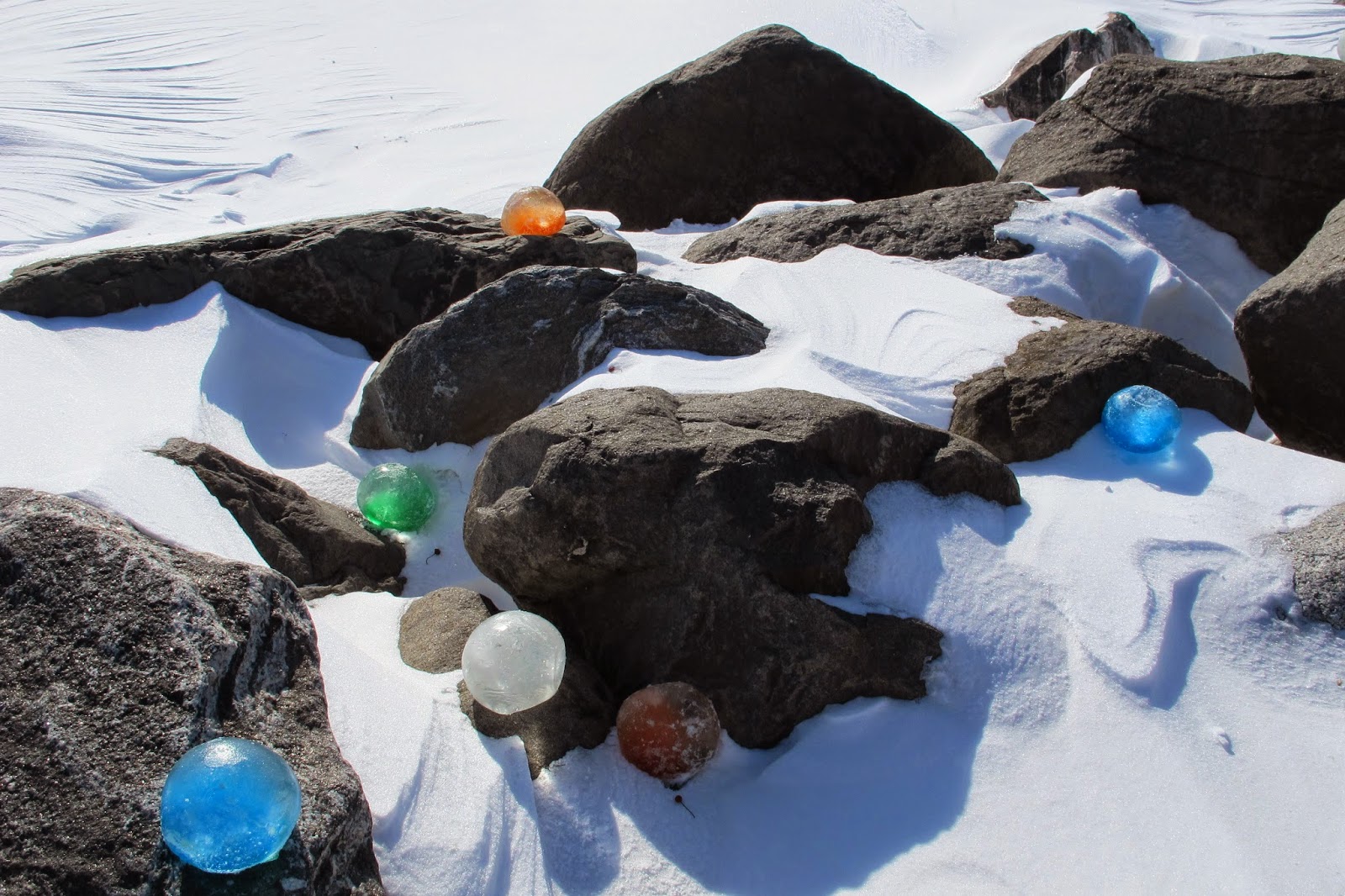
This installation of frozen color was short-lived. 
I was the only lucky soul out there for a few minutes on Monday, in the bright sunshine, just after a big snow. I saw a bald eagle flying low over the open water of the Yahara River. I've not seen one here before.

Another few inches of snow came down on Tuesday. Now the orbs of frozen color are covered in an icy blanket. But I suspect a few people will wander out onto Lake Mendota, near the Tenney locks, and wonder about those dots of color, peeking through like a little sprinkle of something magical.


Frozen Color: Creating Art with Kids


"I dreamed about how we could do it," my daughter said, and she meant it very literally, I think. It was before breakfast, she was full of enthusiasm, and she described to me how she wanted to arrange frozen water balloons on the rocks at nearby Reynolds Park.


The frozen color installations have been our winter thing. We started by making a bunch of water balloons with food coloring, then decorated our front yard with the frozen orbs. Considering my advocacy for our neighborhood parks, and a desire to see more public art installations, I started dreaming about other spaces that could use a frozen splash of color.

In part, I wanted to add to the winter palette. I also wanted to put action behind an idea I've be pushing here on the blog: that it is easy to add to the vibrancy, culture, and community with simple creative acts.


And I love creative collaborations with my kids. 

Three years ago, right after my daughter's second birthday, she was painting on her new easel. She painted carefully, experimenting, obviously in the flow of creativity. I watched, took pictures, stayed out of her way. Then she declared with conviction: I love art. I love this art. I love you art.

Later that night, I took out my letter stamps and added her quote to the painting. It was our first collaboration.


A couple weeks ago, at Tenney Park, my kids arranged some frozen color under one of the lagoon bridges. I loved watching them own the project. Again, I stood back and took pictures.

In the weeks since, I've happened on other beautiful frozen color in neighbors' yards. It makes me smile and brightens my day. Maybe you are like me and these little things make all the difference, make this place feel more alive, more friendly, more fun.


Another Madison-based blogger has started a Creativity Club. I'm the joining type, so I said "I'm in" out loud. The monthly creativity challenges are designed for anyone. For me, I'll use them to propel some of my collaborative art escapades around town.

Even if you are not the joining-type, but you want to be more of the doing type, check out the Creativity Club. Meg justifies the push she provides: "The thinking about the thing, the googling the thing, the talking about the thing. Those are not the thing. The doing is the thing. The making is the thing."

The Creativity Club challenge this week, by the way, is to quote yourself and illustrate that quote. It reminded me: I love art. I love this art. I love you art.


Follow along #thecreativityclub and #frozencolor

Check out a very cool past winter installation, as well as one that seems perhaps worth a field trip!

What Makes Tenney Park So Unique?

On a very cold but sunny afternoon last week,
I let the kids loose on the frozen lagoon with ten colorful orbs of ice.

Tenney Park is unique. I've lived near it for a while now, but it was when I walked the park paths daily to get my daughter to nap that I really got to know its varied landscape. I noticed the different birds, including some zippy yellow ones that sparked my imagination(orioles? tanagers? warblers? who knows?) . I noticed just how many languages can be overheard regularly. And I learned that by crisscrossing the varied paths, I could keep the baby sleeping for long stretches as I found areas of seclusion and other areas often busy with activity.

The history of the park is unique. It started as fourteen acres of marshland bought in 1899 by a local citizen, Daniel Tenney. From the beginning, he intended the land to be a park and promised to give it to the city of Madison when the city was ready to take care of it.


I told them to make a sculpture.
I told them their art would be enjoyed by all the skaters on Tenney Lagoon.
They took the task very seriously, despite the cold and wind.

Mr. Tenney's vision for parks not only generated what is now a rather large park, more than 37 acres along the shoreline of Lake Medota and the Yahara River, it also pushed Madison to be the park-rich city we know today. I'm always proud to remember, Madison has twelve parks and seven playgrounds per 10,000 residents, which is more than other cities. 

This fact was established by park-loving settlers of the capitol city. According to the Madison Parks Foundation history page, "By 1909, Madison had a population of only 25,000, yet a quarter of a million dollars in private funds had been raised just to build public parks, this at a time when a dollar was worth $20 in today's money."


The three kids, ages 2, 4, and 5, pushed and placed the orbs.
At one point, they stopped to play on the groomed ice.
Then they went back and rearranged the orbs.

Mr. Tenney personally underwrote the construction of the first five footbridges in Tenney Park.

After they had finished, and I was taking pictures, I tried what I had watched the kids do: the orbs glide like air hockey pucks into new positions gracefully.

I hope our city's future builds off this history. Recent and upcoming restoration projects are set to keep Tenney vibrant and unique. The Tenney-Lapham Neighborhood Association's current newsletter includes information about the projects, as well as the devastation expected from the Emerald Ash Borer.

Some meetings to note:  

Date: Tuesday, January 13, 2015
Location: Tenney Park Apartments, 302 N. Baldwin Street

The City of Madison Parks and Engineering Divisions are hosting a public information meeting to discuss two separate projects that are proposed for Tenney Park in 2015.  For each topic, a brief presentation will be given, followed by a question and answer session.


  • Tenney Park Beach Playground Improvements – 6:00 pm.  Follow-up to the Oct. 15th public input meeting.  City Parks will seek input regarding playground design options for Tenney Park Beach Playground.  Contact: Sarah Lerner, 261-4281 or slerner@cityofmadison.com.


  • Tenney Lagoon Shoreline Restoration & Tenney Park Bike Path Reconstruction – 7:00 pm.  Discuss proposed project to stabilize and restore all shorelines along Tenney Lagoon and reconstruct the park path that parallels Johnson Street.  Contact: Sally Swenson, 266-4862 orsswenson@cityofmadison.com.


The kids are now talking about where they would like the next ephemeral splash of color to land. 

Three Reasons Public Art is Good Even When It Is Bad


I love public art. Not all of it; some I find tasteless or ugly or boring. But I'm supportive of it all on principle and want more of it. I define public art broadly to include murals and bronze men-on-horses, as well as the Bubble Car with the fantastic bubble-wand-waving-man in the Willy Street Parade.

The Cap Times recently celebrated a crop of new projects in an article in its weekly paper. The piece hails the projects and the resulting art products as "people's art" that take inspiration from the community. This is a great point, and one of the things I like about public art, but not the only reason public art is of value.

Many of the projects in the article were unknown to me. I was excited to read about them but frankly would have been way more excited had I stumbled upon them. And that is what I love most about public art: the discovery! Being surprised by the sighting of some public art can transform how I see the place and change the tone of my day.

The newly installed CommuniTree was the cover image for the article by Lindsay Christians. This life-size tree was built with the help of community volunteers, has a time-capsule buried beneath it, and was funded, in part, by the Marquette Neighborhood Association.

Now there is a yellow dot on the trunk of the CommuniTree. The yellow dots are all over the City marking Ash trees that are slated for removal in the City's plan to deal with the Emerald Ash Borer invasion. The yellow dots-of-death are all over my neighborhood and I wish they were not.

People are buzzing about this 'act of vandalism' that supposedly makes a statement about the art itself (that the CommuniTree should be removed?).

Whatever. Like a friend who covered the yellow dot on the tree in his terrace with brown paint to hide the tree from the cutting crew, I personally thought the 'act of vandalism' was clever. I wish I didn't need to make this clear, but I will: I really like the CommuniTree and love Erika Koivunen's work.


Public Art is like that: Open for interpretation. And here are three more reasons why public art is good, even when it is bad:

1. Public art is fun. Just last week, Livability.com released its rankings for 2015 and Madison is number one. Livability is about quality of life, which means that we are having a pretty good time of it. Public art is different from high art, the kind that hangs in museums, in that it is out there having a good time with the people. And people want to be where the art is (developers know to follow the hot chefs and the artists). And that is my criticism of the CommuniTree: you cannot sit under it. I had to cross two lanes of traffic and stand on a traffic island to get close enough to see the beautiful detail of Erika Koivunen and Aaron Howard's work. That's not fun.

2. Public art is collaborative. The artist commissioned to do a piece has to work with the people who want the art. The artist with an idea for a piece looking for a public stage has to work with the city and neighbors to get permits and permission. And the artist living life artistically (like the man in the Bubble Car making the bubbles) is engaging with the community. This engagement is really healthy for a city and underscores the point that artists make valuable collaborators on projects of all kinds. When artists are part of a project team, alongside the other specialists, the project generally ends up being more accessible to the community and ultimately more effective.

3. Public art generates conversation. Whether it is "I saw the neatest thing today" at the dinner table or "That pillar of footballs looks phallic," I'm solidly behind an enhanced urban landscape that inspires further expression. One of the more exciting conversations I had with my four-year-old was in response to an art installation that was part of Reflections from the Banks of the Yahara. She wanted to talk about how the piece was made, what the artist was thinking, and what kind of art she would like to create. I co-curated the temporary installation, so was thrilled that the public art was working.

*****

Have you heard about the murals? Have you seen the latest in the Little Galleries? Have you ever witnessed all those Santas caroling on State Street? These are things to experience, and talk about!


Is Music the Answer to all our Development Questions?


Living in the heart of Madison of downtown Madison in 2014 is a little hectic. There are a lot of issues on the table and it's hard to know which ones to get worked up about, which ones really matter, where to put my own energies. I care about parks, public space, art & culture, biking conditions (i.e. traffic), and generally good-living in an urban setting. All this adds up to community. In current parlance, it's also related to place-making. 

Just last week, we neighbors got a big announcement via the newspaper:  A developer "plans" to build a large music venue on the 1000 block of East Washington. It kinda came out of nowhere, I thought, and I actually follow these things a little. Naturally, it created a big stir of concern. Those of us that live within spitting distance wonder who has been talking to who? A 2000+ seat concert hall coming to our neighborhood? Where are those people going to park, for one thing? And is it designed to appeal to those of us within walking distance? And why across the street from a large, open-air stadium recently refurbished to host things like concerts? Or a block from the new Central Park, also a venue this summer for many music stages?

So, the question is about public input. Generally I really, really think that people should do more, talk less. I mean, who really wants to go to a million meetings over the course of many years to discuss ongoing plans? That is one of the reasons I get behind the place-making model. It's about people doing their good ideas, however small and insular, because they all add up to great stuff that defines a place and makes it cool. It's Lighter, Quicker, Cheaper, and it works, according the experts. 

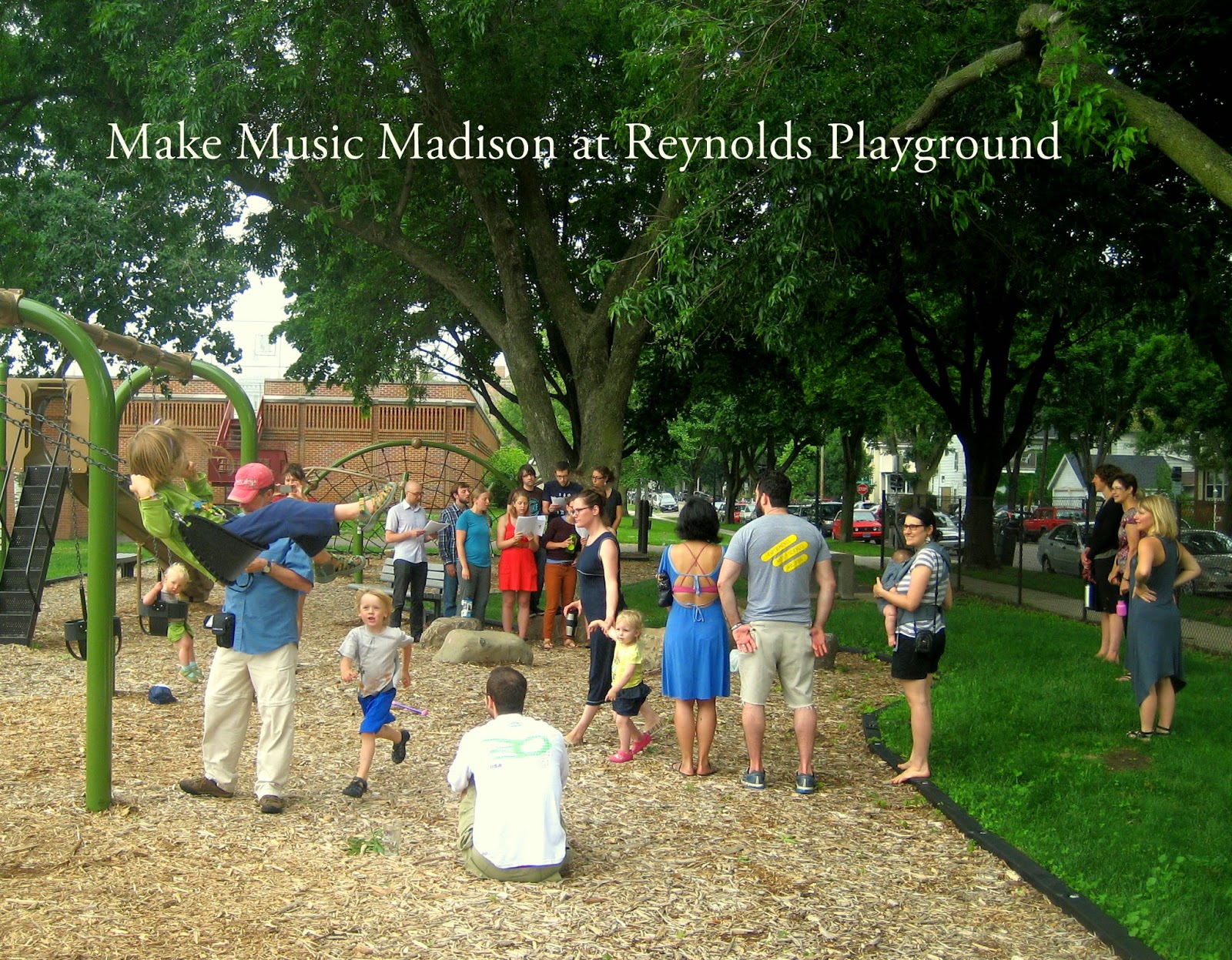
The scene at Reynolds Park on the Solstice made me so happy. It was perfect, and I don't imagine a single meeting was held to organize it. When it's a good idea, just do it, right?! A group of friends who sing together signed themselves up to perform as part of the Make Music Madison line-up (though their performance didn't make it into the schedule). The small crowd that gathered to enjoy was just so sweet, and everyone seemed to content to be there. 

Months ago I wrote a little wishlist and hoped someone would make some music happen at Reynolds. I knew I had too many things going on to be in charge, but I sure did want to be a happy bystander. Because music makes a place into a place-to-be. And Reynolds has the potential to be a great place to be.

Make Music Madison is only in it's second year, but it has momentum. "Performed by Anyone. Enjoyed by Everyone." Indeed. The city was alive on Saturday, music on so many corners, people out and about, mellowing out and enjoying the vibe. 

Ironically, the night before the announcement about the 2000+ seat music venue, I was at a meeting with a group called Willy Wash. This group envisions a corridor of smaller music clubs, along with a music-based charter school, performance spaces in parks, and more. Music, music, music. They are thoughtful people, cognizant of the importance of gathering input and building a community of interest. However, from what I can tell, few from the public seem to attend their open meetings. And they didn't seem to know anything about the coming announcement, either.

Do we just have too many things to think about (the Public Market? the East Johnson Street construction and how to support the businesses? what is the Salvation Army planning to do? is the tech start-up really happening? are property values and air quality going to drop while energy bills spike when all those gorgeous trees come down? was it not actually a tornado that came onto the isthmus?) to attend meetings? Or does everyone have their own agenda and insist on going their own way. When is it better to go the diy way?

Thirteen years ago, or thereabouts, someone must have had the idea to start a Tenney-Lapham art walk. This year, a neighbor artist named Ken Vogel got out of his studio and exhibited some of his amazing puppets, thanks to a friends' encouragement. I brought home a singing, banjo-playing Pete Seeger. Thank goodness some people can just have a good idea and then do it without making too much trouble. 

I'd add Smaller to the the recipe for good place-making.


Why the Fools Flotilla matters

2014 Fools Flotilla, photos by Ray Pfeiffer Komifoto

We have wheels made specifically for rolling a canoe on pavement. My two kids are small enough they can both ride in the canoe to be pulled the 0.42 miles from our house to the Yahara River for the annual floating parade. They look forward to canoe rides of all kinds, happy to wear their life-jacket outfits and play with big-stick-practice-paddles. The oldest has memories of past Flotillas. 

The Fools Flotilla was started by a friend of mine, so the first year I went for her, to be supportive. This year I actually had fun. The kids are not so small anymore, so I relaxed and enjoyed the atmosphere instead of fretting about tipping over or pinching little fingers. We All had fun.

But those other years, I wondered a little why we were doing it. It is my kind of thing - costumes, community show of funkiness, nature + culture. And yet it's some work to get the family wrangled on a Sunday morning for organized fun. I think now it matters for these reasons, if not more:

1.  It's a holiday. Many of the holidays we celebrate are prescribed, defined, and constrained by a variety of things. We are not necessarily celebrating what we truly believe. Yet for as long as anyone can remember, people have celebrated holidays. It seems like part of what makes us human. I like that for my family, we have a few holidays that are not on the regular calendar, but that do what holidays are supposed to do as far as I'm concerned: mark the passing of a year, take us out of our normal routine, bring us together with people we enjoy hanging out with, and remind us of the beautiful things in life. In this case, the Fools Flotilla is a way for my family to say we value our river and green space in our neighborhood, we see connections between art and nature, and we are not opposed to dressing silly, making a scene, and living creatively.

2. We need visionary community leaders. These are not the people who are doing very important jobs to deal with urban issues, conduct studies to plan development, find and manage money, and keep the place working. We live in the First World, we assume things work, we complain about our First World problems, and we have hobbies. What gets people excited is a vision in action. People show up to be part of it, and it's because visionary leaders are catching us in the gut, helping us to see what we, too, believe is a better way. I love that the Fools Flotilla is growing - there were more than 50 boats in the river this year - organically, building an audience of fans along the banks and on the bridges. It's not huge, but it's gaining a real, organic momentum that will, I think, be critically influential in the coming years as big decisions are made about the future of the neighborhood and city. This TED talk is about how great leaders inspire is worth watching. 


3. Creativity is contagious and temporary art is memorable. Madison's BLINK program, funded by the Madison Arts Commission, is founded on the truth that ephemeral public art makes a big mark on individuals and a place (in contrast to the traditional public art that looked like a famous and now-dead leader riding a horse). I personally remember art that surprises me, makes me smile, leaves me feeling like I had an experience. The Fools Flotilla inspires us who get in boats, at least, to push our own boundaries of creativity. Some people decorate their boats, other people decorate themselves, their kids, or their pets. I think all of us enjoy having creative outlets, we all benefit from being exposed to more expressions of creativity, and it's really cool when families find ways to make art together.

4. It's playful. It's good for adults to have an excuse to play. I loved pounding on my canoe like it was a drum when the surge of boats passed under the bridges. The huge, collective echo-beat was awesome. The band played songs like "Row Your Boat" we could all shout along to. I was so swept up in the big game of it all, I was shocked when I looked at my watch. I had been in the flow, having fun, playing right alongside my kids and my husband. Another TED talk here by Csikszentmihalyi, who figured out that flow makes people happy.

So now I'm fully on board. I joined the River Alliance of Wisconsin, I'm talking up the Flottila at community meetings, and I'm keeping the memories alive with my kids. Have you been to May Day in Minneapolis? It started small, too.

BLINK and the art is gone.


The exhibition will come down in two short weeks. If you didn't make the walking tour with the artists (John Miller in the picture above), get out there and see it quick!


In theory, I want you to be surprised by each piece. I want it to be your own discovery, a wonderful serendipity that makes you feel like you are momentarily on vacation in your own neighborhood. I want you to be so excited, you tell people "You'll never believe what I saw today while biking/boating/walking by the river..."


But if it takes pictures you make you curious, or photos on facebook to make you feel like you are missing something, that's fine, too. I've seen lots of people stopping to take pictures of the art, laughing, curious, seemingly having a good time.


My family has twice now made the occasion to picnic under this tree and installation by Thomas Ferrella. My kids call this whole thing "my art project," which is a concept familiar to two and four-year-olds. It has been my project for the past months and I'm thrilled with how it turned out. Thanks to everyone involved, my co-curator Helen, and Karin at the Madison Arts Commission. Thanks for going to see it all, enjoying it, and coming up with more ways to make life fun and inspired!

Meet Me at the River

 
Do you know exactly how far you live from the Mighty Yahara?

I'm looking for friends and neighbors who would like to be part of my art project called "Meet me at the River."

For two weeks in early June, I will put signs in yards within a 3 mile radius of the Yahara River pointing to the Yahara River. The signs will tell you how many miles it is from that spot to the River.

The signs will be part of the temporary installation of public art works by community artists called Reflections from the Banks of the Yahara River that I am co-curating.

Anyone can volunteer their yard. I'll provide a pedometer for those who want to do the walk themselves to determine the mileage.

The signs will be small, but big enough, and made of wood. They will pound into the ground easily, and come out without trouble.

The idea is for people to notice, maybe just one, maybe a few, take note, talk about it, wonder what is going on, and have a pleasant little encounter with public art.

Some people will hopefully follow the signs and head for the River, where they'll find artwork by a number of artists along the parkway.

And for those who host a sign, you might remember to walk down to the River more often. At least, you may remember to head that way to watch the annual Fools Flotilla float by on a Sunday morning in early June. You may even hop in a boat and join revelry as part of the water parade.

Please contact me or comment here if you would like to volunteer your yard!


Call for Public Art Projects: Reflections from the Banks of the Yahara River


This is a call for artists to submit ideas for a collection of outdoor artworks to grace the banks of the Yahara River on Madison’s east side. The temporary exhibition is being organized by neighbors, for neighbors, and will be on view in June of 2014 during the weeks leading up to the Marquette Waterfront Festival and the annual Fools Flotilla. The Flotilla is a floating parade organized by the River Alliance of Wisconsin on the Sunday of the Festival.

The public art installation is being organized to provide interactive experiences and encourage reflections about the Yahara River and Parkway. The organizers will apply for a BLINK! grant from the Madison ArtsCommission to support this temporary public art experience.

What is it about the Yahara River?

Is it a gem in the heart of the city? A diamond in the rough, or a shining jewel? What do you see from the water’s edge? From a boat or a bridge? How do you use the river? Or the parkway? What is missing?

What could a little art do to enhance the place? Start a conversation? Make a point? Create a reflection?

The Yahara River used to be called the Catfish River. It is part of the larger Yahara watershed, a tributary of the Rock River, and mixes with the waters of the Mississippi River at the Gulf of Mexico. It was named the Yahara in 1855 and the parkway and paths along the river were completed in 1906.

Before that, the meandering river and marshland were used as a dump. The Yahara River Parkway was the first park funded by donations from regular people, instead of large gifts from a few donors. They wanted a pleasant place for neighbors to enjoy nature in the city.

In the past 19 years there have been 7 plans and studies making recommendations for the Yahara River Parkway. It was designated a City of Madison Landmark in 1995 and is on the National Register of Historic Places.  

The Yahara River “offers tremendous possibilities; not only is it a neighborhood resource, but it offers the citizens of Madison a vast amount of untapped recreational opportunities.”  -a 2013 official statement made by The City of Madison  


Submission Details:

  • Provide a description of the proposed work, including size and materials and installation requirements. Responsibility for fabrication, installation, maintenance, and removal of the artwork is assumed by the artist.
  • Conceptual Approach Statement explaining how the proposed work will enhance  appreciation of the Yahara River/Yahara River Parkway.  You may include a paragraph describing how participation would advance your art form.
  • Your site(s) of choice. You may want to include a photo or map of the site. The organizers will work with selected artists and the City to get necesaary permission and permits. Please note that preferences for locations are not guaranteed.
  • Resume or work history. Residents, neighbors, makers, and other creative visionaries are encouraged to submit ideas. Do include photos of previous creations (up to 5 digital images of previous work with descriptions of the projects) that indicate your ability to realize a proposed project.
  • Send to bikerbecker@yahoo.com. Digital files can be shared via dropbox or as attachments.
  • Deadline: Monday, December 16, 2013.  Decisions will be made and announced by January 1, 2014.

Additional Information:

  • Up to 4 proposals will be selected. We are looking for projects that are feasible and that reflect the theme of the proposed project ‘Reflections from the Banks of the Yahara River.’
  • Proposals may be for a collaborative piece. You need not be an established or professional artist.
  • Reimbursement for supplies up to $250 may be available, contingent on grant funding (an application for a BLINK grant will be submitted in Feb. 2014).
  • The organizers will work with selected artists and the City to get necessary permits. Please note that once projects have been selected, these permissions and permits are not guaranteed.


Making the Effort: Experiencing Art with the Kids

"Plenty" by Katey Smith, Gail Simpson and Aristotle Georgiades

Gallery Night this fall was another little window into all that is cool about my neighborhood right now, at this moment in history. 

Experiencing art with kids makes me appreciate it differently. It's less about seeing the best, new works and more about getting into the space to celebrate that people are making art for us to enjoy.


We had a ball at Art In on East Washington. The space feels is a bit hidden, in the way the best art spaces are, and when you walk in you know you've entered a zone of collective, creative, even cutting-edge work. My daughter was so excited she spontaneously started doing wacky yoga gymnastics moves in one of the galleries. And that felt right. In fact, all the little people found each other and had their own sort of gallery night social hour.

Where I grew up, the "Gallery Hop" happened the first Saturday of the month in the hippest neighbhorhood in the city. As a high school kid looking for cool, I found the vibe and lots of inspiration in this zone of galleries, street performance, and folks dressed up to be seen.

In Madison, the galleries that participate in the twice-a-year Gallery Night are spread out all over the city. This effectively makes it a neighborhood art night for me, since it's pretty unlikely I'll shuttle around town to see everything.

As a family, we wandered within radius of our house to check out the Bright Red Studios. The kids were impressed by Jen Ahlstrom's hanging lamps made from pages of books. Reminds me of a quote I read recently (at an exhibit called Radical Amazement at Hillel) by Abraham Joshua Heschel about how it's completely radical and amazing when we stop taking ordinary things for granted and see them in new light.

Writing this blog helps me notice the streets, shops, and places of my neighborhood and city. Taking the time to reflect also encourages me to want to be more involved, add my own creative energy, and care about how the city evolves.

A blog magazine called GOOD is making a GOOD City Index:  "We want to hear about street corner revolutions and studio space innovation. Places where citizens are valuing connectivity, creativity and equality over commercialism and property prices. We want to hear about the places we might like to move to, to work in, or visit—not because they're perfect, but because they're interesting and have just the right mix of energy, people and possibility. And we want your help."

No comments yet from Madison-flag wavers (Milwaukee, Minneapolis, and Chicago all represent...). I'm not sure I want to be the one, for some reason. I'm noticing that so many of my friends agree that Madison is a great, if not GOOD, place to live. Why do we seem to want to keep that a secret? Is it hurting us or helping? Or maybe no Madisonian's but me read that blog...

I would add to the GOOD Index the importance of access. And by that I mean access to rural, natural, and open space. I love that I can get out of  Madison and into the country really easily. And "the country" is gorgeous, storied, and rich with resources.

Like the Fermentation Fest D-Tour, based out of Reedsburg and organized by the Wormfarm Institute. It's like gallery hopping the farms and fields of the rolling hills of beautiful Wisconsin. It's an art experience. It does take some effort, especially if you have to unbuckle and buckle two car seats for every stop, but it took our collective breath away. Made me see the landscape, and my place in it, anew. Helped me appreciate this moment in history, connected to all other moments. Part of the eternal now. Part of the big picture.

"Consider This" by John Miller
PS: Earlier this month the Williamson-Marquette Neighborhood was recognized as a Top 10 Great Neighborhood in the United States by the American Planning Association. “Marquette has a vibrancy that is a benchmark for other neighborhoods,” said Mayor Soglin at a ceremony the Wil-Mar Neighborhood Center on October 4. “It is our SoHo.”

Read the Willy Street Blog post for the story.

Ten things to do at Reynolds Park and the power of ten

This gorgeous building on East Washington is where Mautz Paint lived for years.
It is just ripe a new incarnation.

9 things to do currently at Reynolds Park:

- play a field game (like kickball, ultimate frisbee, baseball)
- check out the view from on the rooftop of the water utility building (while watching bike polo)
- read the TLNA newsletter
-eat an ice cream cone from nearby Madtown Pizza (or a taco from the cart outside Breese Stevens Field when the Madison 56ers have a game, or sip a coffee from Johnson Public House...)
- fly a kite
- play with your dog
- play guitar
- have a picnic
- watch construction trucks

According to current thoughts on what makes a place people-friendly, you need ten things to do there. The City of Madison has adopted the power of 10 idea and Mayor Soglin, being the practical leader that he is, suggests that the slogan "Lighter, Quicker, Cheaper" is a no-brainer.

Fred Kent, an urban planner of the new variety from the Project on Public Spaces, was the keynote at the 1000 Friends of Wisconsin's conference on Monday. I found the whole day so interesting. I could write ten blog posts in ten million directions.

For example, ten things I heard about my neighborhood, which in City parlance is the Cap East district:

-It is "the next place to be" (that is a slogan I think someone was paid to come up with!)
-The timing is bad for making East Washington any more people friendly because the big construction project was just done.
-The City has a new transportation plan that presumes we will have light rail eventually.
-The Yahara River is now [suddenly/finally] understood to be a hugely under-appreciated area. (We've known that, of course.)
-Replacing the living lawn at Breese Stevens Stadium with astro turf means that it can be used for festivals and concerts in the future. The bathrooms are going to be dealt with. Parking, however, is not yet figured out.
-Increased parking needs, and traffic patterns in general, are not yet figured out. Underground parking is not an option due to the soil on the isthmus.
-The developer of The Constellation, Otto Gebhardt, has turned down chain restaurants that want the ground-level space. He's holding out for the perfect local foodie place. Google is moving in to the second floor office space.
-The guys who are proposing to redevelop the old Mautz Paint building into Starting Block talk like it's happening, but the City guys talk as if it's still an open conversation.
-The tennis courts on top of the Water Utility building at Reynolds Park are going to be resurfaced.
-Local landowners and long-time business owners in the Cap East district are tired of being left out of the conversation about the area's future. The time is ripe for these interests to claim their voice and to be represented as a BID, or Business Improvement District. Madison has one BID (Downtown Madison/State Street), while Milwaukee has forty.

Orange snow fencing surrounds the Reynolds Park playground area right now. Big metal playground equipment, concrete trucks, bulldozers and other major landscaping implements are on their way.

On the lighter, quicker, cheaper model, I'm mentally planning a party in the park that will throw open the new space to welcome neighbors new and old to enjoy it. A spring-time party to celebrate.

There are at least 10 things I'd like to see happening at the Reynolds Park party of the future:

-Kids climbing the new boulder
-People lounging on the hills
-Grills hot and cooking food for sharing
-Community members embellishing chain link fences with temporary installations of color
-A kids's marketplace of lemonade stands and bake sales
-Face painting. hoola hooping, bubble making, unicycle riding, stilt-walking
-A band playing under the trees
-Blankets, folding chairs, and impromptu benches made from pallets, logs, and crates
-Sign-making to note all the varieties of flowering vines along the fence on East Mifflin
-A DJ dance party on top of the water utility building

This stuff is easy. Reynolds Park is ready to go from inadequate to extraordinary. But the new playground equipment alone will not transform the park into a welcoming place. A good place feels good and people want to be there. It has to be a multi-use destination (not just a park) where people interact with the space dynamically. Of course, not because we are intent on "placemaking," just because it is attractive and feels like the most natural thing in the world to do.

Seriously, that rooftop is a secret asset! I want to find 10 ways to use it!

Keep Calm and Ride On


If only cars made art as they moved across the pavement! Like, blue lines for cars going the speed limit, red lines for cars with noisy mufflers, green lines for road rage, and rainbows for buses and taxis. Every night at midnight the slate would wipe clean for another day of street art. We'd get to see the reality of our traffic patterns while also making the intersections colorful and unique.

It is actually legal to paint the pavement in Madison. An ordinance was passed earlier this year, though the details are still being worked out by the City's Traffic Engineering office. Some folks think it's a terrible idea to let neighborhoods decide to draw permanent pictures in the middle of intersections, but a quick Google search for "painted intersections" hits on some images I personally find inspiring. I suppose they could go out of style, like a goofy mural, but it seems like a risk worth taking.

The problem is that cars are zooming through our neighborhood streets as if there are not kids playing, pedestrians crossing streets, and people riding bikes. On top of that, loads of new people and their cars are moving in to the current and coming developments on East Washington. More will come for the Metcalf's grocery they are building. At the same time bicycle traffic is actually being encouraged onto the official East Mifflin Street "bike boulevard."

I've heard way too many stories of near misses. Traffic experts in the city reassure us that it's no worse in our neighborhood than elsewhere. I believe them.

An ad-hoc committee of neighbors has formed. They met in early September. They are doing their homework and have strong recommendations for traffic calming measures. I'm impressed, because no one really has time for more meetings, and I'm relieved, because I want it to get done but am personally more interested in other things. I'm also, frankly, a little shocked that it takes a group of regular folks who have had the misfortune of nearly getting killed while crossing the street to tell City experts, who presumably have degrees in traffic engineering, what to do. Traffic diverters, pedestrian islands, "chokers" and traffic calming circles.

Pictures painted on the ground. There is a movement in nearby St. Paul, Minnesota called Paint the Pavement. It is "a program that promotes community building and “placemaking” through creating neighborhood art. We support groups of neighbors to organize to create their own public mural on low-traffic residential streets. Neighbors come together, gather support, create a design, petition for approval by the City of St. Paul, and hold a “paint day” to create and celebrate their own community square."

In Madison, where we are also being encouraged to label what we do as "placemaking," black-top murals are not to be confused with traffic calming measures. Which I think is good because I can get more excited about art than speed bumps.


In my estimating, if we embellished some of the chain link fences, put up a large and noticeable colorful sculpture in Reynolds Park, and painted some patterns at the intersections around the school and park, we'd be doing better than most neighborhoods. Cars would slow down and people would know that the place is alive, interesting, and worth a few extra moments to cruise through.

I guess the trouble would be if then the "tourists" started clogging our streets! Then we'll need the traffic calming circles after all. Let's just work all the angles now: slow the cars and make the art and empower the community! It's all good.


The street in front of this house in Detroit is also covered in colored dots!