This will generate Open Graph meta tags for t
Showing posts with label Madison with a Family. Show all posts

In Appreciation of our Educators

McPike Park was dedicated in April 2018 in honor of of Milton McPike, former principal of East High School.

My guess is that most of us don't remember our school principals, or at least not nearly as well as we remember our teachers. But principals can make a big impression. As a parent, I understand that they set the tone for the school and model leadership.  

The naming of a central park in our city seems like a fitting honor for Principal McPike's exceptional role in this east-side community.

I was impressed when a friend told me she applied for a transfer to East High School while he was in charge. She left her own neighborhood school in order to be part of a school that valued diversity and inclusion under Principal McPike's leadership. She remembers him well, saying he really took time to build personal relationships with his students. 

Tammy Thompson Kapp was the first principal I got to know as a parent. When my daughter started kindergarten at Lapham Elementary School, she welcomed my family. We got to know each other and worked together on several projects. I especially appreciated her ongoing advocacy for a crossing guard at the corner of Ingersoll and Dayton Street. Principal TK worked really hard to make this important safety measure a reality.

On the first day of school this year, Principal TK's legacy was solidified for my family when I greeted the brand new crossing guard. 

Principal TK has moved on now and Lapham Elementary School has a new principal. Her name is Cathy Prozanski and I'm excited to share some of her ideas and interests so we can get to know her and welcome her to the community. 

The new crossing guard at the corner of East Dayton and Ingersoll on a busy first day of school.

Meet the new principal of Lapham Elementary School, Cathy Prozanski!


Me: Where are you from and what are you most excited about in Madison? 

Cathy: I am originally from Edgar, WI which is a small town west of Wausau. I grew up on a farm there. I am the oldest of four kids, and have three younger brothers. I went to college at UW-Eau Claire where I received my B.S. in Elementary and Special Education. I received my Master's Degree in Ed Leadership from Viterbo University. My husband and I have five children, four boys and one girl. We moved to Madison because we wanted to be in a larger city with more diversity and more fun things to do. We love the Badgers and the excitement of living in a bigger city, where there are always things to do.

Me: What do you find most interesting or exciting about Lapham School? What excites you about this first school year?

Cathy: I love that Lapham is a 4K-2 building. The learners at this age have unique needs and when the building is only this age group, many things can be tailored to early learners. I am also excited about the growing diversity of the school. First years are always a bit anxious but I am looking forward to getting to know everyone. I love change but I also love the familiarity that grows from change.

Me: What is the most interesting and inspiring trend in education you see right now?

Cathy: The focus on the cultural components of education. Trying to meet the needs of our under served populations. I truly believe that all students can learn at high levels and strive that we can meet that goal at Lapham. I also like the trend of partnering with parents on a level that involves learning. Home visits and daily communications that involve exchanges of information that allow parents to support their child through the educational process.

And a few more questions from my kids...


Kids: Where do you hide the donuts and coffee?

Cathy: Sorry I don't drink coffee and try to not eat donuts. lol

Kids: What is your favorite snack?

Cathy: Chips. I love chips. 

Kids: When kids hear you making announcements on the loud speakers in the classrooms, where are you talking from and how does it work?

Cathy: I use the phone in my office. I dial a special number and it goes through the speakers. 

Kids: What are some of your pet peeves?

Cathy: When people are unkind. Everyone is going through their own growing and learning. Sometimes that journey is more difficult. Everyone deserves empathy.


A huge thanks to Cathy, and welcome to the Lapham family!

Cathy and her family


You are Invited to the 5th Annual May Picnic in the Park


Sunday, May 3 from 11-1 at the Yahara Place Park

Bring a picnic. Bring a blanket. Bring a jacket, as it always seems to be extremely windy (like nearly blowing the May Pole down kind of windy). 

Flower crowns are, of course, welcome. 

And please bring an instrument, if you play one. We need some help this year in the music department. 

Our wonderful musician friend Tim has moved away, and our other wonderful fiddling friend Daithi has another commitment, so we are depending on the fates to bring music to the park so that the children may dance

Thanks for your help spreading the word! This is the 5th May Picnic in the Park. The first one, in 2011, was also advertised with one of Milo Vander Zanden's drawings. Read more about our local tradition here.

2011 drawing by Milo Vander Zanden

Spinning the Globe to Bring Home the Best Souvenirs


People say that travel opens your eyes to see more clearly where you come from. People say that we need to teach our children global competencyPeople say that the internet is changing everything and the First Global generation is poised to produce new kinds of leaders.

When my daughter lost Marge, her beloved doll, at age three, she told us the doll had gone on a trip to India for a while. Marge did not remember to take a camera, so we have no images of her adventures.

Both my kids, not yet school-age, have stamps in their passports. I am a well-traveled 40-year-old, but I didn't get my first passport until I was six. The kids are beating me already at one of my most-valued life pursuits. 

We just spent a week at a resort south of Cancun, so nothing particularly exotic. There are better ways to raise a culturally conscious kid. However, since returning, I cannot stop thinking about the world, and how to experience more of it. So for the past week I've been surfing the web for inspiration from around the globe.

With just a few clicks, I'm connected to both the amazing (and atrocious) stories of what is happening on this planet. We can all, so easily, follow along, help fund, and learn lessons from these innovative projects.

Can bring these ideas, like souvenirs, home to Madison?


In Santiago, Chile, a dull plaza was transformed by a Shanghai-based group called 100architects. They say "You used to play in the street: Try it." Who paid for this, got the permits, invited this to happen? I don't know. But I think the idea is easy to copy and know of several 'dull plazas' in my landscape that could use some jazz hands.

In the Netherlands, it is common for people to have benches in front of their homes. They are on the sidewalk but are privately owned. It is accepted that anyone can use the bench and that no special permission is needed from the city to put the bench there. And, of course, there are no concerns about lawsuits or homeless campers. Ah, the Netherlands, land of loveliness, right? BenchesCollective riffs off the Restaurant Week model: For one day, folks offer something to the public using the benches for the setting. 

Here in Madison, we have porches...


Markets are universal. The world over, you can count on the fact that people have to sell and buy food. When traveling, markets are the best places to visit. Our Farmers Markets are wonderful, but I'm so hopeful that soon, we'll (once again) also have covered public markets

If you haven't yet heard, East-Sider Meghan Blake-Horst is attending the International Public Markets Conference in Barcelona, Spain. She is the power-house visionary behind MadCity Bazaar, which will be popping-up on the corner of E. Wash and 1st Ave two weekends a month from May through September. 

I'm so excited that it is her style, and sensibility, that will help shape the Madison market scene of the future. 

I'd like to see Madison swapping spit around the world a bit more. 

What are your global inspirations? How would they look, and work, here?


How I transformed this space, just a little bit


I have reworked this digital space a bit recently. I wanted to make it more beautiful, but am limited by the restrictions of the blogger geography and my own capabilities. So, I just added some pages to help organize my ideas.


It is not unlike the art I've been doing this winter: simple embellishments to the familiar landscape.


Years ago, when my husband and I were still dating, we stopped for a hike at a little patch of woods off the highway on the outskirts of Madison. My memory of that hike feels like a dream. We left the main trail to follow a little 'deer path' that led us into a world of sculpted vines and created space. The stones and logs were placed to create small coves beneath dense canopies. It was both totally natural and utterly magical.


We never figured out if the space was created by artists or by area children.


I was reminded of that artful installation within the woods today when I looked at some pictures a friend shared with me.


I added a section that I hope answers the questions I often ask myself, like Why do I enjoy creating this digital space for myself so much? And what is it for?


I've also made it easier to subscribe (see the right sidebar) and added some local sponsors. Thanks for looking around here, and outside, and exploring with me. Keep sending me links, too, I love that!


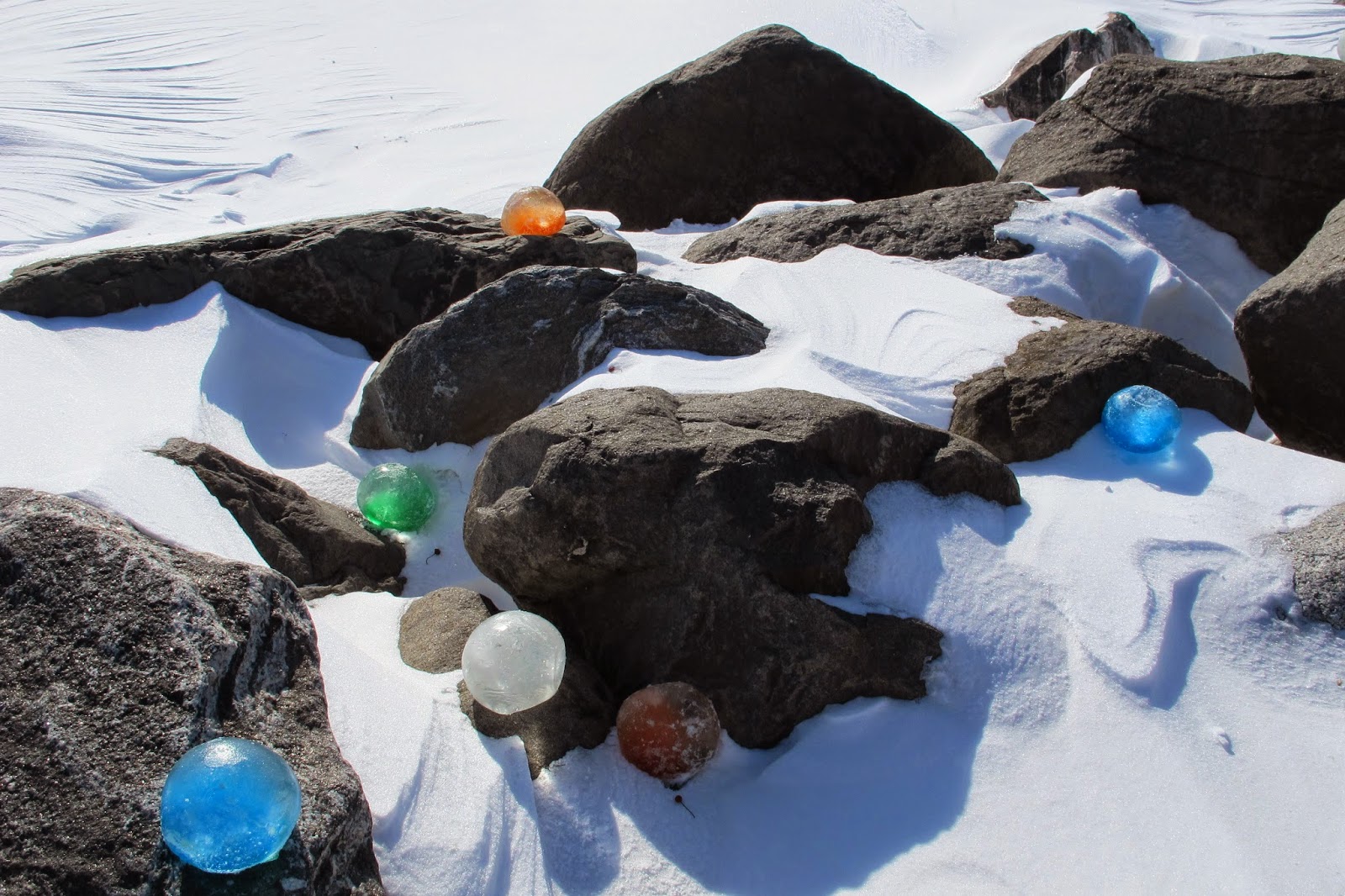
This installation of frozen color was short-lived. 
I was the only lucky soul out there for a few minutes on Monday, in the bright sunshine, just after a big snow. I saw a bald eagle flying low over the open water of the Yahara River. I've not seen one here before.

Another few inches of snow came down on Tuesday. Now the orbs of frozen color are covered in an icy blanket. But I suspect a few people will wander out onto Lake Mendota, near the Tenney locks, and wonder about those dots of color, peeking through like a little sprinkle of something magical.


Frozen Color: Creating Art with Kids


"I dreamed about how we could do it," my daughter said, and she meant it very literally, I think. It was before breakfast, she was full of enthusiasm, and she described to me how she wanted to arrange frozen water balloons on the rocks at nearby Reynolds Park.


The frozen color installations have been our winter thing. We started by making a bunch of water balloons with food coloring, then decorated our front yard with the frozen orbs. Considering my advocacy for our neighborhood parks, and a desire to see more public art installations, I started dreaming about other spaces that could use a frozen splash of color.

In part, I wanted to add to the winter palette. I also wanted to put action behind an idea I've be pushing here on the blog: that it is easy to add to the vibrancy, culture, and community with simple creative acts.


And I love creative collaborations with my kids. 

Three years ago, right after my daughter's second birthday, she was painting on her new easel. She painted carefully, experimenting, obviously in the flow of creativity. I watched, took pictures, stayed out of her way. Then she declared with conviction: I love art. I love this art. I love you art.

Later that night, I took out my letter stamps and added her quote to the painting. It was our first collaboration.


A couple weeks ago, at Tenney Park, my kids arranged some frozen color under one of the lagoon bridges. I loved watching them own the project. Again, I stood back and took pictures.

In the weeks since, I've happened on other beautiful frozen color in neighbors' yards. It makes me smile and brightens my day. Maybe you are like me and these little things make all the difference, make this place feel more alive, more friendly, more fun.


Another Madison-based blogger has started a Creativity Club. I'm the joining type, so I said "I'm in" out loud. The monthly creativity challenges are designed for anyone. For me, I'll use them to propel some of my collaborative art escapades around town.

Even if you are not the joining-type, but you want to be more of the doing type, check out the Creativity Club. Meg justifies the push she provides: "The thinking about the thing, the googling the thing, the talking about the thing. Those are not the thing. The doing is the thing. The making is the thing."

The Creativity Club challenge this week, by the way, is to quote yourself and illustrate that quote. It reminded me: I love art. I love this art. I love you art.


Follow along #thecreativityclub and #frozencolor

Check out a very cool past winter installation, as well as one that seems perhaps worth a field trip!

What Makes Tenney Park So Unique?

On a very cold but sunny afternoon last week,
I let the kids loose on the frozen lagoon with ten colorful orbs of ice.

Tenney Park is unique. I've lived near it for a while now, but it was when I walked the park paths daily to get my daughter to nap that I really got to know its varied landscape. I noticed the different birds, including some zippy yellow ones that sparked my imagination(orioles? tanagers? warblers? who knows?) . I noticed just how many languages can be overheard regularly. And I learned that by crisscrossing the varied paths, I could keep the baby sleeping for long stretches as I found areas of seclusion and other areas often busy with activity.

The history of the park is unique. It started as fourteen acres of marshland bought in 1899 by a local citizen, Daniel Tenney. From the beginning, he intended the land to be a park and promised to give it to the city of Madison when the city was ready to take care of it.


I told them to make a sculpture.
I told them their art would be enjoyed by all the skaters on Tenney Lagoon.
They took the task very seriously, despite the cold and wind.

Mr. Tenney's vision for parks not only generated what is now a rather large park, more than 37 acres along the shoreline of Lake Medota and the Yahara River, it also pushed Madison to be the park-rich city we know today. I'm always proud to remember, Madison has twelve parks and seven playgrounds per 10,000 residents, which is more than other cities. 

This fact was established by park-loving settlers of the capitol city. According to the Madison Parks Foundation history page, "By 1909, Madison had a population of only 25,000, yet a quarter of a million dollars in private funds had been raised just to build public parks, this at a time when a dollar was worth $20 in today's money."


The three kids, ages 2, 4, and 5, pushed and placed the orbs.
At one point, they stopped to play on the groomed ice.
Then they went back and rearranged the orbs.

Mr. Tenney personally underwrote the construction of the first five footbridges in Tenney Park.

After they had finished, and I was taking pictures, I tried what I had watched the kids do: the orbs glide like air hockey pucks into new positions gracefully.

I hope our city's future builds off this history. Recent and upcoming restoration projects are set to keep Tenney vibrant and unique. The Tenney-Lapham Neighborhood Association's current newsletter includes information about the projects, as well as the devastation expected from the Emerald Ash Borer.

Some meetings to note:  

Date: Tuesday, January 13, 2015
Location: Tenney Park Apartments, 302 N. Baldwin Street

The City of Madison Parks and Engineering Divisions are hosting a public information meeting to discuss two separate projects that are proposed for Tenney Park in 2015.  For each topic, a brief presentation will be given, followed by a question and answer session.


  • Tenney Park Beach Playground Improvements – 6:00 pm.  Follow-up to the Oct. 15th public input meeting.  City Parks will seek input regarding playground design options for Tenney Park Beach Playground.  Contact: Sarah Lerner, 261-4281 or slerner@cityofmadison.com.


  • Tenney Lagoon Shoreline Restoration & Tenney Park Bike Path Reconstruction – 7:00 pm.  Discuss proposed project to stabilize and restore all shorelines along Tenney Lagoon and reconstruct the park path that parallels Johnson Street.  Contact: Sally Swenson, 266-4862 orsswenson@cityofmadison.com.


The kids are now talking about where they would like the next ephemeral splash of color to land. 

Neighborhood Development: What makes a House a Home?


What makes a neighborhood into a community? What makes a bunch of houses into homes?


I've lived on my street a long time. Last year, two sisters, ages 9 and 11, asked me to help to kick off a Halloween parade. Thinking back, that was a turning point for me.

This year, my 4-year-old daughter was the true hostess of the parade. Only the second annual, it is to her an institution. She is proud our home is so central to the event. As families gathered in our front yard before walking about a block and a half together, she welcomed everyone personally, offered treats and admired costumes. My mother joked it was as if she were running for mayor.

In fact, we had delivered flyers to houses and apartments where we knew children lived. Sometimes we were just reading clues, like strollers and push-toys in yards. We wanted to be sure everyone felt invited. 

Happily, I am getting to know my neighbors better as the years go by. Lately, we have had a lot to talk about. Many of us are getting organized around a shared vision for the future of the neighborhood. 

We have started a petition specifically to oppose a proposal to build a large music venue on East Washington, on the block next to Lapham Elementary School. We support smart development that respects and enhances the neighborhood. We are working to update playgrounds, to maintain area parks, to strengthen the local businesses, and to support Lapham Elementary School and the young people growing up around it.

It feels great to be part of a community that is place-based.


It means that I want to stay put for Trick-or-Treating. For years, I sat on a friend's front porch handing out candy to kids in the Jenifer Street neighborhood. I watched all those kids grow up and raided their candy haul for Mounds bars.

Now I am building community from my own front porch. On Halloween, adult friends dropped by to show off their costumes, steal my kids' candy, and eat chili and cornbread. After our kids were finally in bed, we sat around a neighbor's bonfire and talked. 

Really talked. We reminded ourselves: This is worth making time for. Community is a value and a practice. We are so very lucky to be here.


If you would like to sign the petition, please be in touch. Find the facebook page "Tenney Lapham for Smart Development." Thanks!

[The petition=We the undersigned residents of Tenney Lapham neighborhood support the development of the 1000 block of East Washington but OPPOSE the inclusion of the large capacity music club proposed by Frank Productions. We are proponents of smart development that will enhance and not detract from our quality of life. A large capacity music club does not belong in a residential neighborhood.]


Three Reasons Public Art is Good Even When It Is Bad


I love public art. Not all of it; some I find tasteless or ugly or boring. But I'm supportive of it all on principle and want more of it. I define public art broadly to include murals and bronze men-on-horses, as well as the Bubble Car with the fantastic bubble-wand-waving-man in the Willy Street Parade.

The Cap Times recently celebrated a crop of new projects in an article in its weekly paper. The piece hails the projects and the resulting art products as "people's art" that take inspiration from the community. This is a great point, and one of the things I like about public art, but not the only reason public art is of value.

Many of the projects in the article were unknown to me. I was excited to read about them but frankly would have been way more excited had I stumbled upon them. And that is what I love most about public art: the discovery! Being surprised by the sighting of some public art can transform how I see the place and change the tone of my day.

The newly installed CommuniTree was the cover image for the article by Lindsay Christians. This life-size tree was built with the help of community volunteers, has a time-capsule buried beneath it, and was funded, in part, by the Marquette Neighborhood Association.

Now there is a yellow dot on the trunk of the CommuniTree. The yellow dots are all over the City marking Ash trees that are slated for removal in the City's plan to deal with the Emerald Ash Borer invasion. The yellow dots-of-death are all over my neighborhood and I wish they were not.

People are buzzing about this 'act of vandalism' that supposedly makes a statement about the art itself (that the CommuniTree should be removed?).

Whatever. Like a friend who covered the yellow dot on the tree in his terrace with brown paint to hide the tree from the cutting crew, I personally thought the 'act of vandalism' was clever. I wish I didn't need to make this clear, but I will: I really like the CommuniTree and love Erika Koivunen's work.


Public Art is like that: Open for interpretation. And here are three more reasons why public art is good, even when it is bad:

1. Public art is fun. Just last week, Livability.com released its rankings for 2015 and Madison is number one. Livability is about quality of life, which means that we are having a pretty good time of it. Public art is different from high art, the kind that hangs in museums, in that it is out there having a good time with the people. And people want to be where the art is (developers know to follow the hot chefs and the artists). And that is my criticism of the CommuniTree: you cannot sit under it. I had to cross two lanes of traffic and stand on a traffic island to get close enough to see the beautiful detail of Erika Koivunen and Aaron Howard's work. That's not fun.

2. Public art is collaborative. The artist commissioned to do a piece has to work with the people who want the art. The artist with an idea for a piece looking for a public stage has to work with the city and neighbors to get permits and permission. And the artist living life artistically (like the man in the Bubble Car making the bubbles) is engaging with the community. This engagement is really healthy for a city and underscores the point that artists make valuable collaborators on projects of all kinds. When artists are part of a project team, alongside the other specialists, the project generally ends up being more accessible to the community and ultimately more effective.

3. Public art generates conversation. Whether it is "I saw the neatest thing today" at the dinner table or "That pillar of footballs looks phallic," I'm solidly behind an enhanced urban landscape that inspires further expression. One of the more exciting conversations I had with my four-year-old was in response to an art installation that was part of Reflections from the Banks of the Yahara. She wanted to talk about how the piece was made, what the artist was thinking, and what kind of art she would like to create. I co-curated the temporary installation, so was thrilled that the public art was working.

*****

Have you heard about the murals? Have you seen the latest in the Little Galleries? Have you ever witnessed all those Santas caroling on State Street? These are things to experience, and talk about!


While I Push Piles of Stuff Around, please tell me: Is it worth the trouble to consign that Stuff?


My first daughter knows the story of how, when she was born, we were not prepared for her. She surprised us in arriving a full four weeks before her due date and we literally had only the swaddling blanket we brought home from the hospital. She owns this part of her history, how we wrapped her in super-soft flannel pillowcases.

Now, of course, we have way too much gear. It happened really fast. We bought a bigger house in an attempt to accommodate the huge amount of stuff we acquired, along with the two children who occasionally use it. But no attic, garage or basement would ever be big enough.

The piles had gotten intolerably large just as my 4 year-old's growth spurt necessitated some shopping, so I decided the time was right to "do" the Half-Pint Resale. It's one of those things that seems like part of parenting in Madison. If not a rite-of-passage, then just the way one does things.

The Half-Pint Resale is 14 years old, involves over 550 consigners and thousands of shoppers. There are loads of rules, like "The main way to attach your tags is with a safety pin. We recommend having the pin go through the clothing TWICE to secure the tag. For extra security, put a piece of tape on the tag where you plan to put the safety pin to reinforce the paper and prevent the tag from falling off the item."

Consigning is a huge commitment in time, energy, supplies, and faith. I do lots of things for which I make no money, accrue no sick leave, nor earn a pension (like write this blog), and lots of things that go un-praised and unappreciated. Yet the work of consigning was hard on me.

I couldn't help tallying up the workload (3 evenings that ran way past my bedtime) and inputs (Ziplock bags, Avery labels, safety pins, tape) against what I imagined my stuff to be worth to others. I doubted my sanity, and my ability to reckon with the way other people might value my stuff, over and over.

Earlier this summer, at a yard sale, my kid asked me to buy her a plastic toy tea kettle. It had a lid and wasn't broken, but it was in a plastic storage tub full of the loose-change of the toyworld. When I asked the seller how much for the toy, I was offended to have to hand over a dollar (I didn't lower myself to bargaining but instead just whined about the seller's audacity to my husband later). So, when I was labeling those Octopus Robeez, which I bought second-hand, with a $3 sticker, I felt like a chump, though I couldn't say if that was too high, or too low, a price.

A friend of mine has an awesome playland in her back yard that she boasts has been in over 10 yards on the east side before it was passed lovingly on to her family. That is mostly how things work and I like it best.

Yet, still, I just had to do it. Once. Now I've done it. 

I conscripted my mother into helping me sort stuff for one late night. I added packs of kid-size hangers to my husband's Target list. I waited in line to drop off my bins of stuff (1.5 hours), arranged childcare so I could shop during the special early-bird hours for consigners (on a Friday evening!), and now nervously anticipate which of my big items will sell.

I'm so glad for the two women who started the very-successful, efficiently run, and well-respected Half-Pint Resale. It's a great boon to Madison, and a much better way to shop for winter boots for fast-growing kids.

I'm glad I earned my patch for what feels like an accomplishment. I won't begrudge the Yard Sale Lady next time, maybe. And I'm thinking that I'll wait a couple years before I even consider consigning again....when my daughter is old enough to make her do the work of tagging her own stuff. I won't mind hearing her tell that story some day, how her mom made her sell all her toys in a big warehouse overflowing with storage bins of Robeez.

This is no typical school garden & the story of too much compost


You have probably noticed the raspberries. Even if you don't have school-age kids, if you have walked on the 1000 block of East Dayton, the ripe red berries are hard to miss. They poke through the chain-link fence surrounding the Lapham Elementary School garden like a lure during the summer.

The fence has expanded recently, not to accommodate the raspberry bramble but instead to make room for new fruit trees. My kids like to play at the school playground in the summer, so I spend a lot of time pushing them on the swings while I ponder the garden that runs the length of the playing field.

Now that I know more of the story, I wish there were a sign. Something parents could read while their kids played, or maybe a plaque on the fence near the raspberries for passers-by. Because the story is great, and it is one the neighborhood can be very proud of.

It might say something like:

This garden is a model for how school gardens work. 

  • Every student at Lapham participates in classroom visits to the garden where they plant, harvest and taste food. 
  • Families take turns caring for the garden in the summer and take home the fruits of their labor. 
  • Extra produce goes to the Wil-Mar Center Food Pantry. 
  • Special grants have funded the garden expansion, as well as an irrigation system, nine fruit trees, hand-crank blenders, a wheel-chair accessible path, a solar oven, and a garden classroom. 
  • A salaried Garden Coordinator facilitates activities so that classes spend time in the garden every week (even the gym, art and music classes spend time in the garden).
  • This garden benefits kids, their families, and the neighborhood.


*****

I see a friend of mine at the garden watering sometimes, so I asked her to tell me about it. She has been part of the Lapham Green Team for a couple years and has written the big-deal grants that are allowing the garden to grow. She loves the garden; says that it changed her. She feels now a part of the community in a way she didn't realize was possible and says she is committed to the garden beyond when her daughter graduates from Lapham.

"It all started because there was too much compost," she said to explain the recent expansion. Every kindergartner collected their own compost for just a week last year. They put it on scales, talked about diverting trash from landfills, and learned the biology of soil. A group called REthink is committed to innovate waste management solutions, so they helped the Lapham kids with the compost project. They all concluded that a larger garden was necessary to handle that much compost.

Now the garden is twice as big, and this fall the entire school will be composting for two months. I have a hard time picturing the enormity of that pile. Of course, that is one out of three meals, and only one school out of fifty in the Madison Metro School District. It's a lot of food waste, and a huge learning opportunity.

Many schools have gardens, but the Lapham garden is lucky to have a very supportive principal. Unfortunately, that is not to be taken for granted. The principal has made the garden part of the School Improvement Plan (all schools have a SIP) so that she can allocate resources into the garden and teachers are empowered to extend their classrooms outside.

Happily, the garden will be getting a sign, thanks to a grant specifically for Art in the Garden! All the students will be part of creating the three-dimensional mosaic tile sign. Lapham's Artist in Resident Lynn Lee, as well as Midwest Clay Project, will be guiding the project.

And the sign, proudly, will announce the new, totally appropriate garden name:


Lapham Outdoor Classroom 
and Community Garden!


*****

I'm so glad to know this story. I am inspired by the common heroes of my neighborhood.

The sunflowers, now more than the raspberries, are the visual stunner but, in just a couple weeks, the sounds of children in school, yet outside, will be more impressive...now that I know the story.


What parents of young kids in the Tenney Lapham Neighborhood need to know


My sis was just in town with her son. They live in Boston and my nephew will start at a Montessori pre-school this fall after spending his first two years with a nanny. She really thinks things through thoroughly and makes good decisions.

Thinking ahead to kindergarten, she is wondering how to weigh all the factors in her choice. Of course the school district matters, but her big question was, What are the personally relevant criteria to use in evaluating a school? 

I'm the older sister so I appreciate that she asks my advice, even if I thought about none of these possible criteria and just bought a house. I want to be my sister when I grow up, but for now I surf on my instincts and intuition.

Lucky for my kids, we bought a house three short blocks from the best nursery school I could ever have dreamed up: Flexible scheduling, amazing teachers, intimate setting, and integrally part of the history of the neighborhood we live in.

Two mornings a week, we leave the house about 5 minutes before the "Hello Song" begins for our short stroll, or roll. On the way, we convene with our neighbors also en route to Tenney Nursery and Parent Center. It is totally idyllic, by my personally relevant criteria.

Every year, about 100 families join the secret club. Unfortunately, it is too much of a secret. In contradiction to the perception that it is really stressful to "get a spot" in a good nursery school, Tenney is underenrolled for fall 2014! What?!?! Sign your kids up now!

TNPC was started in 1979 by a group of families in the Tenney Lapham neighborhood. I imagine that 35 years ago, the neighborhood must have been teeming with young kids, as it is today, and progressively-minded parents who were looking for creative and flexible solutions to childcare. Because it was founded by parents for their families and neighbors, the everlasting sense of community is amazing.

That was the era of cooperatives, a movement with a very rich history in Wisconsin. Today, there is a continuity to that history at Tenney: teachers who were once students, teachers who taught current kids' parents, that kind of thing. It's a real community.

Both my kids started Tenney at age 2, and both will be there until they begin Kindergarten (with their friends, at a school a few blocks away). They are in different, age appropriate classes, but because there are only three classrooms, and such a small number of children served, they will play together in the gym, on the gorgeous playground, and during Lunch Bunch.

It's not "Montessori" or "Waldorf" or any of the in vogue styles of education. It is simply nursery school in the most classic, and to my mind perfect, sense: the play structures are all built of wood and encourage imaginative play; the kids spend loads of time outside; art and story are integral in the curriculum; the kitchen is used for cooking healthy snacks; and the teachers cover all the official Pre-K basics.

I love that my neighborhood is so full of young children. I think it is in part because of the reputation of the local schools. I hope that Tenney Nursery Parent Center can also be the draw it deserves to be as the neighborhood heads into an interesting future.

Parents of young kids (age 2 and under) can drop in for Toddler Time on Fridays to check it out!


Why the Fools Flotilla matters

2014 Fools Flotilla, photos by Ray Pfeiffer Komifoto

We have wheels made specifically for rolling a canoe on pavement. My two kids are small enough they can both ride in the canoe to be pulled the 0.42 miles from our house to the Yahara River for the annual floating parade. They look forward to canoe rides of all kinds, happy to wear their life-jacket outfits and play with big-stick-practice-paddles. The oldest has memories of past Flotillas. 

The Fools Flotilla was started by a friend of mine, so the first year I went for her, to be supportive. This year I actually had fun. The kids are not so small anymore, so I relaxed and enjoyed the atmosphere instead of fretting about tipping over or pinching little fingers. We All had fun.

But those other years, I wondered a little why we were doing it. It is my kind of thing - costumes, community show of funkiness, nature + culture. And yet it's some work to get the family wrangled on a Sunday morning for organized fun. I think now it matters for these reasons, if not more:

1.  It's a holiday. Many of the holidays we celebrate are prescribed, defined, and constrained by a variety of things. We are not necessarily celebrating what we truly believe. Yet for as long as anyone can remember, people have celebrated holidays. It seems like part of what makes us human. I like that for my family, we have a few holidays that are not on the regular calendar, but that do what holidays are supposed to do as far as I'm concerned: mark the passing of a year, take us out of our normal routine, bring us together with people we enjoy hanging out with, and remind us of the beautiful things in life. In this case, the Fools Flotilla is a way for my family to say we value our river and green space in our neighborhood, we see connections between art and nature, and we are not opposed to dressing silly, making a scene, and living creatively.

2. We need visionary community leaders. These are not the people who are doing very important jobs to deal with urban issues, conduct studies to plan development, find and manage money, and keep the place working. We live in the First World, we assume things work, we complain about our First World problems, and we have hobbies. What gets people excited is a vision in action. People show up to be part of it, and it's because visionary leaders are catching us in the gut, helping us to see what we, too, believe is a better way. I love that the Fools Flotilla is growing - there were more than 50 boats in the river this year - organically, building an audience of fans along the banks and on the bridges. It's not huge, but it's gaining a real, organic momentum that will, I think, be critically influential in the coming years as big decisions are made about the future of the neighborhood and city. This TED talk is about how great leaders inspire is worth watching. 


3. Creativity is contagious and temporary art is memorable. Madison's BLINK program, funded by the Madison Arts Commission, is founded on the truth that ephemeral public art makes a big mark on individuals and a place (in contrast to the traditional public art that looked like a famous and now-dead leader riding a horse). I personally remember art that surprises me, makes me smile, leaves me feeling like I had an experience. The Fools Flotilla inspires us who get in boats, at least, to push our own boundaries of creativity. Some people decorate their boats, other people decorate themselves, their kids, or their pets. I think all of us enjoy having creative outlets, we all benefit from being exposed to more expressions of creativity, and it's really cool when families find ways to make art together.

4. It's playful. It's good for adults to have an excuse to play. I loved pounding on my canoe like it was a drum when the surge of boats passed under the bridges. The huge, collective echo-beat was awesome. The band played songs like "Row Your Boat" we could all shout along to. I was so swept up in the big game of it all, I was shocked when I looked at my watch. I had been in the flow, having fun, playing right alongside my kids and my husband. Another TED talk here by Csikszentmihalyi, who figured out that flow makes people happy.

So now I'm fully on board. I joined the River Alliance of Wisconsin, I'm talking up the Flottila at community meetings, and I'm keeping the memories alive with my kids. Have you been to May Day in Minneapolis? It started small, too.